Java scanner next line
Problem with scanner.nextLine() in program
The last two words in that quote box explain why the method is named. One possible solution is suggested in this old post of mine. Simply calltwice.That API link wrote:. . . Advances this scanner past the current line and returns the input that was skipped. This method returns the rest of the current line, excluding any line separator at the end. The position is set to the beginning of the next line. . . .
I think it is better to write a utility class which can be used forever.You have several options about line 25, which removes whitespace from the text. If you miss out, you might get an input all whitespace: “ ”. Themethod was introduced in Java11; for earlier versions try the trim() method.
[edit 1]Readers are welcome to use that code, but please everybody attribute its origin.
[edit 2] You may do well to make the nextLine() method take a Stringparameter and inse
Java Scanner nextLine() Method
Description
The java Scanner nextLine() method advances this scanner past the current line and returns the input that was skipped. This method returns the rest of the current line, excluding any line separator at the end. The position is set to the beginning of the next line. Since this method continues to search through the input looking for a line separator, it may buffer all of the input searching for the line to skip if no line separators are present.
Declaration
Following is the declaration for java.util.Scanner.nextLine() method
public String nextLine()Parameters
NA
Return Value
This method returns the line that was skipped
Exception
NoSuchElementException − if no line was found
IllegalStateException − if this scanner is closed
Getting Next Line of a Scanner on a String Example
The following example shows the usage of Java Scanner nextLine() method to advance the scanner past the current line. We've created a scanner object using a given string. Then we print a line using nextLine() method and then made a check using hasNextLine() if more data is present or not. Once lines are finished, hasNextLine() returns fal
Scanner nextLine() Method in Java
Briefly about Scanner class and how it works
Roughly speaking, java.util.Scannerclass allows you to read input from various sources, including the console. It really looks similar to a classical scanner. This hardware device has complicated architecture, but it’s pretty simple to describe its work. Scannerreads a date that a user puts on it, such as papers and keeps the data in memory like a picture or pdf file. Java scanner, just like a real one, reads data from the source that you specify for it. For example, from a string, from a file, from a console. Then it recognizes this information and processes it as needed. For example, the program asks to enter some data from the console and reads it or wants to read it from a file. For this operation, the scanner has several methods combined with the word “next”. Such as next(), nextLine(), nextInt(), nextDouble().nextL 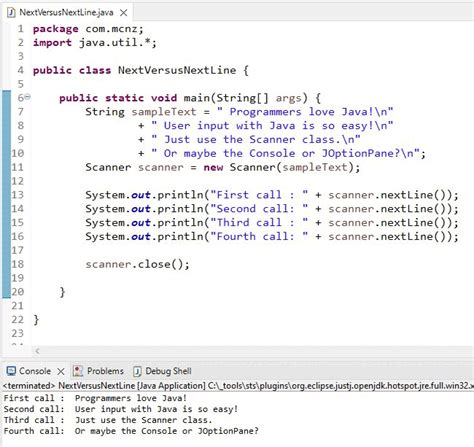 A simple text scanner which can parse primitive types and strings using regular expressions.
 A breaks its input into tokens using a delimiter pattern, which by default matches whitespace. The resulting tokens may then be converted into values of different types using the various methods.
For example, this code allows a user to read a number from :
As another example, this code allows types to be assigned from entries in a file :
The scanner can also use delimiters other than whitespace. This example reads several items in from a string:
prints the obeying output:
The same output can be generated with this code, which uses a regular statement to parse all four tokens at once:
The default whitespace delimiter used by a scanner is as recognized by .. The method will reset the value of the scanner's delimiter to the default whitespace delimiter regardless of whether it was previously changed.
A scanning operation may block waiting for input.
The and methods and their primitive-type companion methods (such as and ) first skip any input that matches the delimiter pattern, and then attempt to return the next token. Both and methods may block waiting for fu
nextline() in Java
Overview
In this article, we are going to learn about the nextline() in java. Before getting started with the topic let us get a short overview of what is a nextline() in java.
nextline() in java : The nextLine() in Java is a method of the java.util.Scanner class. It will read the input string unless the line changes or a new line and then ends the input with \n or pressing enter. Usually, if we are taking any other type of input like int or String word input with the next() method before the nextLine() method we usually add an extra nextLine() method just before the nextLine() method, otherwise the nextLine() method will return a blank String. Another way would be to always use nextLine() wrapped into an Integer.parseInt.
We have got a brief overview of what is the nextLine() in Java. Now let us see the syntax of the nextLine() in Java.
Syntax of nextLine() in Java
Let us now discuss the syntax of the nextLine() in Java.
Declaration :
Explanation :
In the above syntax, we can see the nextLine() reads input only of String type.
Implementation :
Before implementing the nextLine() in Java, we must import the Scanner class in Java from ja
A breaks its input into tokens using a delimiter pattern, which by default matches whitespace. The resulting tokens may then be converted into values of different types using the various methods.
For example, this code allows a user to read a number from :
As another example, this code allows types to be assigned from entries in a file :
The scanner can also use delimiters other than whitespace. This example reads several items in from a string:
prints the obeying output:
The same output can be generated with this code, which uses a regular statement to parse all four tokens at once:
The default whitespace delimiter used by a scanner is as recognized by .. The method will reset the value of the scanner's delimiter to the default whitespace delimiter regardless of whether it was previously changed.
A scanning operation may block waiting for input.
The and methods and their primitive-type companion methods (such as and ) first skip any input that matches the delimiter pattern, and then attempt to return the next token. Both and methods may block waiting for fu
nextline() in Java
Overview
In this article, we are going to learn about the nextline() in java. Before getting started with the topic let us get a short overview of what is a nextline() in java.
nextline() in java : The nextLine() in Java is a method of the java.util.Scanner class. It will read the input string unless the line changes or a new line and then ends the input with \n or pressing enter. Usually, if we are taking any other type of input like int or String word input with the next() method before the nextLine() method we usually add an extra nextLine() method just before the nextLine() method, otherwise the nextLine() method will return a blank String. Another way would be to always use nextLine() wrapped into an Integer.parseInt.
We have got a brief overview of what is the nextLine() in Java. Now let us see the syntax of the nextLine() in Java.
Syntax of nextLine() in Java
Let us now discuss the syntax of the nextLine() in Java.
Declaration :
Explanation :
In the above syntax, we can see the nextLine() reads input only of String type.
Implementation :
Before implementing the nextLine() in Java, we must import the Scanner class in Java from ja